An Oedipus Complex

       It is has been suggested that Hamlet's actions show the he has an Oedipus complex, a sexual desire for the parent of the opposite sex. Freud states the Oedipus complex develops between the ages of three and six, and after either disappears or remains dormant in the mind of the individual. During this developmental time period, the sexual identity of the child takes shape. In boys, sexual desire is directed towards the mother, and the father has now become a rival for the possession of the mother. The child now hates the parent of the same sex. 
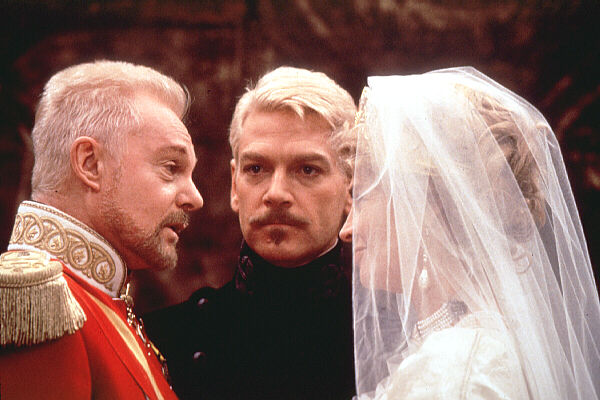
       It is easy to understand the suggestion of an Oedipus complex existing in Hamlet, as he grows angry at mother and uncle for wedding. After King Hamlet's death, Prince Hamlet would have been able to take his mother, but Claudius took her away. Hamlet is obsessed by the idea of his mother and uncle making love. Someone without an Oedipus would feel disgusted at the thought of his mother having sex, but Hamlet even goes to discuss with his mother in her closet. During their discussion, Hamlet forbids Gertrude from having sex with Claudius, which definitely suggests an Oedipus complex. Hamlet is not just angry at his mother for betraying his father, but he is also jealous of his uncle for bedding his mother. Hamlet berates his mother: Nay, but to live in the rank sweat of an unseamed bed, stew'd in corruption, honeying and making love over the nasty sty-- (Hamlet, 3.4.91-94). A normal son would be disgusted at the topic, but Hamlet abuses his mother in the very bed the vile acts occurred. 

Understanding Death


My Dad died when I was five. My dad grit his teeth in physical pain, and my mother, emotionally destroyed, looked at him with sore, sad eyes. To me, his end is very vague and confusing. I didn’t yet understand the concept of death, and couldn’t understand my own father passing away. Actually, apart from the absence it created, I benefited from his death. My five-year-old self hated hospitals, and now there was no need to visit them every day. There was no longer the sharp sting in my nose from disinfectant, and dreary white walls becoming more depressing thanks to the fluorescent lighting. At that age, I knew he was gone, but I didn’t understand that he was unable to come back. I remember saying, “I hope that when daddy feels better he can come back and live with us again.” My sister was blunt with me, “He can’t come back! He’s dead! Don’t you understand?”
I now understand what death means. My Dad died when I was five, but I still feel his absence. I sometimes wonder how different my life would be if he lived. No doubt I would be spared the emotional scaring from his death, but would I be happier? I realized that I am the person resulting from my life experiences. My values, ideas, and fears develop from the ups and downs that I’ve traveled in life. In fact, an Erik Soreide with a father would not be Erik Soreide.
I am jealous of alternate Erik, but to a degree. He would have grouchy, Norwegian father yelling at him in broken English with a heavy accent, while I have a Nebraskan mother yelling at me in plain English. His father would make him play soccer, while I was given the opportunity to choose my own sport. When people ask, “Where’s your dad?” he would respond, “At work,” while I have to say, “My dad died when I was five.” People always react the same way. At first, they are surprised, then they return an “I’m sorry.” I hate this entire situation most of all because you are not at fault for my dad’s death. Cancer killed him in his bed, and while I do appreciate the sympathy, I cannot stand the pity.
My father’s death has hardened me to the point that death is no longer debilitating. Fortitude isn’t the right word for the situation. Fortitude implies defense against death, but I don’t defend myself. I understand the situation and accept that this person is no longer with me.
The Internet Age and Its Impact on Society


Within the context of “A Measure of Restraint,” ignorance is bliss. The cesium-137 shining like an, “enchanted elfin sprite,” mystified the junk dealer’s niece and many other residents of GoiĆ¢nia, Brazil. If she understood the substance would cause her cells to deteriorate, then she may not have been so excited to cover her face in radioactive cesium.
Curiosity is part of human nature. Similar to the girl’s wonder of the powder, Americans are amazed by the advancement in telecommunications technology. Computers have become a dominant aspect in the American life because of the internet. Social forums and networking sites have solidified the internet’s existence, and allowed for millions of sites to join in the online community. We are at a point in time that almost anything can be found only, which is a blessing and a curse to our generation.
While older generations were forced to tire hours of research in encyclopedias, we can access information in seconds. Want to know how many acres the Okefenokee Swamp occupies? Don’t use books! The internet has the answer! An answer that can be accessed in a microscopic period of time determined by the speed of your computer, bandwidth, and internet provider. This immediate access facilitates research, but leaves the searcher addicted to the provided information. Speed is a danger aspect of the internet. Why read an entire novel by F. Scott Fitzgerald when a synopsis is available free online. Why solve calculus problem uses complex thought when Google you the work along with the answer. The internet takes away our drive to think freely.
Communication is much easier today through networking today. A message to my aunt in Norway would take weeks through postage, and only seconds through Facebook. The task is easier, but communication has become emotionally hollow. Following the internet’s speed capabilities, sending an email or a text message is effortless, and communicating out loud is dying in public. Communication has become so much broader that we have become dependent on other peoples’ information, no matter how meaningless it really is. We are slaves to the information that is literally at our fingertips. Every person is an addict looking for the next information fix.
There also seems to be an illusion of security online. Social networking was enticing at first, but the information left online can have serious consequences to your ordinary life. It offers strangers the ability to view your basic information, and once that information is online, it is nearly impossible to remove. Deleting a Facebook account still retains some of your information in their databases. Our generation needs to learn that we should only use our private information when it is absolutely necessary.
Would our generation be better off without the advancement in telecommunications? Probably not, but the generations impacted by the internet will have severe social disturbances in the future. 

Loss of Meaning


My foreign cousins seemed genuinely concerned when they questioned the Pledge of Allegiance. To them, it is a peculiar act that appears cultish and strange. They argued that American patriotism was nothing more than nationalism. My family rarely discussed the United States while on vacation, but they were visibly upset. I asked what they considered wrong about showing respect for the flag of your country, to which they declared the pledge to be bizarre. They saw it as a rhythm or a spell because it repeats the same three to four word pattern throughout. Bump Bah Bah! Bump Bah Bah! Bump Bah Bah! To them it was brainwashing.
I laughed it off. I argued the Pledge is recited day after day by children, starting in elementary school. These kids may not even know the meaning of the words they are reciting, but continue the pledge because they are forced. Years of recitation void the pledge of meaning, and, as a result, the pledge has no power over an individual. It loses meaning just like a word that has been repeated many times.
This discussion reminded me of standardized testing. I have bubbled so many circles over the years that many tests have lost importance to me. Each test is seamlessly indistinguishable from the last one. Each is labeled with an acronym that doesn’t represent the importance of the test. The ACT is most important for college acceptance, so it’s understandable that some students see no reason to try on the MME’S. All I see is how the district has trained its students to be test takers and to think that the only way to be acknowledged is through a score on a test.
            

How I Alter Public Space


When one alters public space, generalizations are usually based on one’s appearance. With Brent Staples, his characters judge him on the color of his skin and arguably his immense stature. Similarly, I am judged, but not for being a large black man. This week I paid attention to the way people judge me. I realized that the way I am treated is heavenly compared to the years Staples has weathered, and sadly he is only one of many others. Not just black people, but all people. Their torture overtakes my mistreatment, but it feels more apparent because it is personal.
I have whitish blonde hair with a fair complexion. Adults tend to think I don’t tan very easily. They remind me to put on extra sunscreen during the summer. In fact, I crisp to a healthy bronze (a bronze I lose about a week later.) Fellow students have asked if I was albino. The same students have asked if I am a member of the Hitler Youth. In the past, I replied with a defiant “no” coupled with the proud statement of my Norwegian heritage, which lead to nicknames such as “The Viking” and “Erik the Red.”
Years of sports have cultivated by body, so people assume I love sports. While I participate in team sports, I enjoy the camaraderie I have with my teammates rather than the sport itself. To be honest, sports aren’t all that interesting to me. I enjoy a good Tigers game in the summertime, but I only watch games on TV when they are important. That means the Detroit Lions, opening day at Comerica Park, and the Superbowl. That’s about it.
When it comes to altering public space, I don’t really strike fear into men and women. At adolescence, adults tend to dismiss me as just a teenage boy. In my summers, I guard lives at Somerset pools. A number of pools are designated for adults meaning patrons are allowed to drink, smoke, and have a swell time away from children. Sometimes the party gets out of hand and I am forced to calm things down. Unfortunately, I am a teenager which means I have as much authority as mall cop on a public street. No one listens to what I say; no one cares what I say. The drunkards see stubble or disheveled hair and attribute it to laziness. To them I am more likely to be a pot head or a high school dropout than not.
Now that I think about it, I actually judge people based on the way others have judged me in the past. I angrily dismiss questions, I have already answered, and discussions, I have already had, because of the way people have judged me. I am part of the pollution that is judgment.


The Importance of Life


             It’s eleven o’clock on Sunday night. I know I should be placing my concentration on writing my blog post, but the Oscars are distracting me.
            While I do enjoy seeing the various awards, one sequence has always intrigued me more than others. The overhead lights begin to dim as an array of soft, golden sparkles blanket the stage. The somber, reflective music is cued, and the words “In Memoriam” appear on screen.  The “In Memoriam” montage is the only part of the Oscars that I actually watch with my full attention. Please, do not think I enjoy watching the obituary; I am merely fascinated by it. The entire careers of actors, actresses, and other important figures are condensed to a few seconds. It’s strange to think that the importance of your entire life is based on your contribution to the world. In order to be remembered, you have to accomplish something memorable.
            A lot of my Sunday involved the dead, death, or the act of dying. In Virginia Woolf’s “The Death of the Moth,” Woolf expresses how death cannot be avoided. Although the moth embodies life itself, even he cannot elude the arguably most important aspect of life. Death. Without an end to your life, you wouldn’t cherish the time you have on this earth. Death is a deadline, a confine, a boundary. It is the limitation of your existence and the termination of your consciousness.  I often hear the phrase, “Live life to the fullest,” which is a present use for “Carpe Diem.” You have the ability to do what you want with your life. In order to be eternal, you must make the choice to be remembered.           

Where Did You Come From?


In Jessica Cohen’s “Grade A: The Market for a Yale Woman’s Eggs,” Cohen explores the social changes that follow the advancement of modern fertility in a modern world. In the second paragraph, Cohen alludes to Where Did I Come From? A picture book first published in 1973 that explains the reasons and mechanics of sex to squeamish parents’ children. Author Peter Mayle addresses many of the awkward questions from curious kids in his sexual education books. His books seem to age with his readers starting with infancy in Where Did I Come From?, followed by What’s Happening to Me?, which deals with the effects of puberty. Later, Mayle addressed questions, such as Will I Go to Heaven?, Will I Like It?, and How to Be a Pregnant Father. These books contain clever illustrations that appeal to both parents and children, but serve as a way for parents to escape questioning. What is so hard about telling your kids about sex, creation, and life?

Before alternative fertility methods became available, everyone was created from sex. There shouldn’t have been a need for a book to explain this to children. I understand that they should be sheltered from graphic explanation, but vague examples leaves room for confusion. In the piece, David sends Cohen an email with a comic that illustrates an unfortunate outcome of genetics. Cohen understands the literal message, but does not understand David’s implied point. Cohen states, “The message was impossible to pin down.” Her reaction towards the comic is similar to many children reading Mayle’s books. The importance of sex cannot be overstated. It not only leaves a lasting impression on your life, but also on others. It is the parent’s responsibility to acknowledge his or her child’s questions and answer responsibly. Parents should not tip toe around a five-year-old’s simple question. If a child asks a question that a parent knows the answer to, then the parent should answer accordingly with a correct explanation. Do not feed children false information in order to preserve the tender, sensitive innocence of youth.  Of course, a picture book helps kids understand the complex aspects of life, but a knowledgeable
 answer from a wise parent is much more rewarding.

Angelou's Account of Louis v. Carnera


Angelou's account of the Louis v. Carnera boxing match was not factual. Her piece, titled "Champion of the World", expresses her record of the heavyweight bout, but few events occur accurately. The actual fight was not a heavyweight match. It was, however, a match that Louis won on the road to his title match, which occurred two years later.  
On June 25, 1935, Joe Louis defeated the ex- heavyweight champion Primo Carnera in the sixth round. Although “The Brown Bomber” had a serious weight disadvantage, sixty-five pounds under Carnera, Louis used a stalking approach in order to progressively beat down the gargantuan Italian. Through the sixth round, Louis dropped Carnera to the mat three times; however, these occurrences did not result in a knockout. Contrary to Angelou, the fight was ruled a technical knockout in the sixth round. Before Carnera’s body gave way, Louis effortlessly delivered a series of punches to his opponent’s bloody face. Following a left hook, Carnera slumped to a knee. The pride of Italy drove Carnera immediately to rise, but with an obvious absence of functionality. The blood pouring from his face coupled with Louis’ tenacity convinced the referee to call the fight. Announcers considered it an “act of humanitarianism.”
Ultimately, the non-championship fight ended with Louis on top, but not in the way Angelou describes. There could not have been a count, as described in the piece, if the opponent rose to back to his feet. The referee could not have referred to Louis as, “The winnah, and still heavyweight champeen of the world,” if Louis had not yet won a title.
Through class discussion, we concluded that Angelou’s main focus of the piece was not the match, but the high stakes she associated with it. Born in April of 1928, Angelou was only 7 at the time of the fight. Her young age may have led her to incorrectly interpret the situation. As a result, she introduced these events into her piece.